
Servicenow...
To buy, or not to buy?

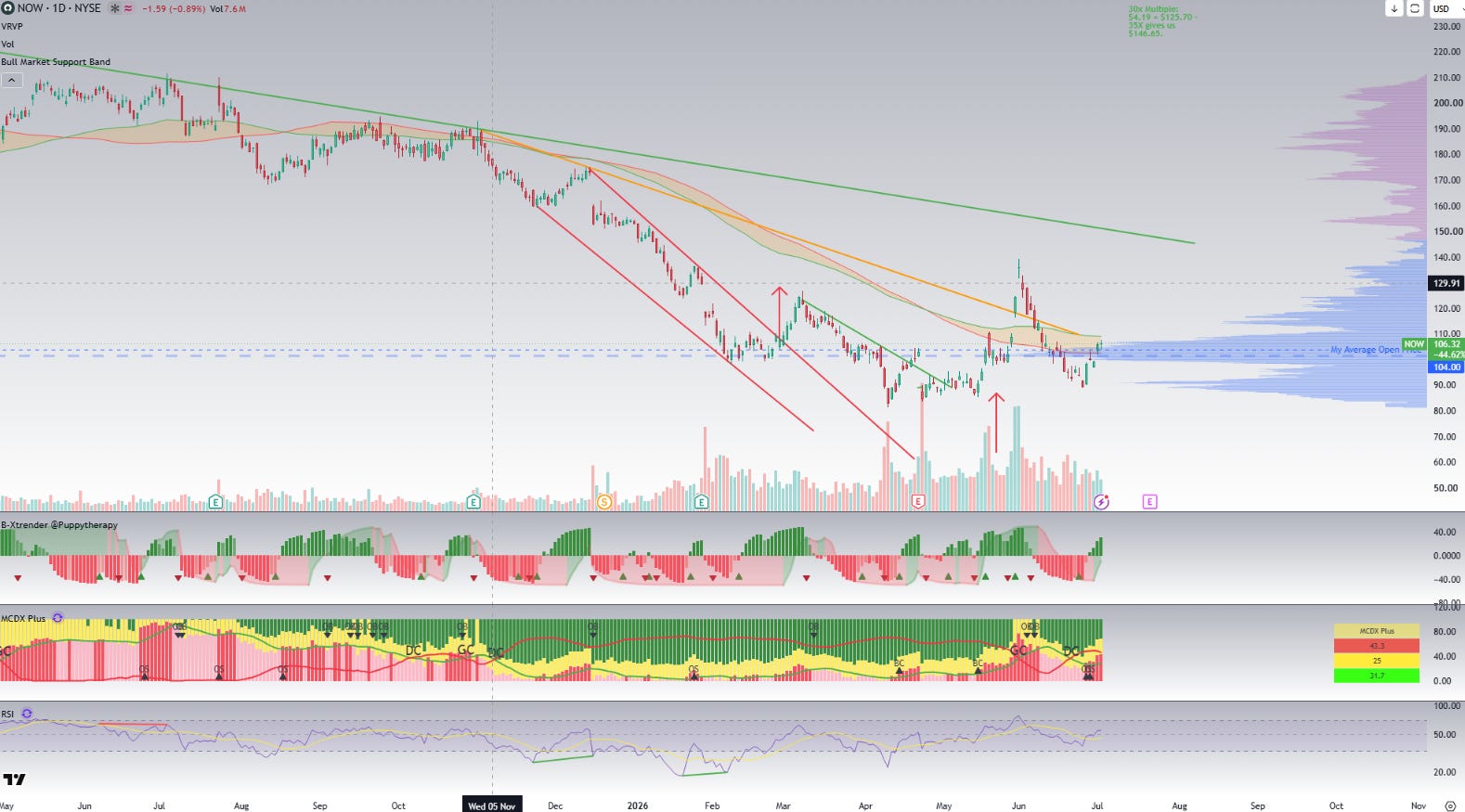
While this stock once traded for over $200, the market has recently been punishing the company, sending it down roughly 55% from its highs. This raises the critical question: are we looking at a massive buying opportunity, or is this a value trap destined to be disrupted by the rise of AI?
Understanding the Sell Off
ServiceNow hit a 52 week low recently, which is a brutal drawdown for a profitable company still growing at 22%. The primary driver of this decline has been a narrative shift on Wall Street. The market has begun to price in a fear that AI agents will make traditional SaaS models obsolete. As a result, many software companies were aggressively repriced lower.
When ServiceNow reported strong earnings, beating revenue expectations and raising guidance, the stock still dropped nearly 18% in a single session. In my view, the market wasn’t just reacting to the next few quarters, it was attempting to reprice the company’s long term terminal value based on the assumption that AI might break its growth narrative years down the line. This discrepancy between the market’s pessimistic outlook and the company’s actual performance had me taking a deeper look into this one.
Why the Business Is Not “Broken”
The bear case rests on the idea that AI will replace the need for workflow platforms like ServiceNow. However, the data paints a different picture:
Stable Demand: On a constant currency basis, remaining performance obligations have remained at roughly 21% for five straight quarters, showing no real deceleration.
High Retention: Renewal rates are hovering between 97% and 98%, and they count 85% of the Fortune 500 as customers.
High Switching Costs: Customers aren’t paying for ServiceNow because of the UI; they pay because the platform acts as the core operating system for their enterprise. Replacing it would take years and cost tens of millions of dollars, creating a massive moat.
AI as an Accelerator: Contrary to the fear that AI will displace them, ServiceNow’s AI product line grew to a $1.5 billion annual run rate in just 30 months.
I work for a large IT company… we use Servicenow, and this is how I would view it: Think of ServiceNow like the plumbing and electrical infrastructure of a massive skyscraper. We spent years mapping the pipes, wiring the walls, and training our staff to manage the system. You wouldn’t rip out the entire foundation and start from scratch just because someone invented a new type of fancy, AI-powered floor lamp. Sure, the lamp is exciting, but it doesn’t solve the core need for water, power, and structural integrity. Replacing our infrastructure for an unproven “vibe coding” solution, which still makes mistakes and lacks the rigorous security standards we require, would be an act of professional malpractice. We aren’t about to throw away years of investment and stability for a tool that can’t handle the heavy lifting of a Fortune 500 enterprise.
I couldn’t think of a better way or explaining this so… apologies :D
The Role of Governance
The most compelling argument for the future of the company lies in the macro trend of AI adoption. As AI agents become more autonomous, they don’t decrease the need for a platform like ServiceNow, they actually increase it.
When intelligence becomes cheap and abundant, the value shifts to whatever provides safe orchestration. ServiceNow provides the governance, identity management, and audit trails required to run these agents securely. Without a governance layer, giving AI agents broad access to enterprise data is a massive security risk. In this new era, ServiceNow isn’t just a tool; it is the essential “toll booth” for AI agents within the enterprise.
Whilst it’s not the same company or product, this is along the lines of the Palantir approach, and they have done ok with it.
My Strategy
I am currently treating this as a swing trade with the potential to turn into a long term hold.
Q2 earnings will be key to watch on this one. If RPO remains above 21% and renewal rates hold, the bull case remains intact, and I will consider scaling into the position further, especially if the price stays close to my current average, which sits at $104.05. Currently I have a sub 1.7% position and at 16 times forward free cash flow, I believe the risk reward profile is currently skewed in my favour!
The problem I have right now, as that there are a lot of great stocks and low prices that I want to buy!